
Portal
Search, discovery, company profiles, trends, routes and competitor watch in one web workspace.

Technology
From billions of shipment records to one plain answer. How the stack gathers, resolves, reads and verifies the world’s trade data, and where the answer lands.
The stack, layer by layer
00Sources
Licensed shipment records, market and policy signals, and company information. The stack starts with what can be checked.
01Gather
Shipment records across 150+ countries, with 1.4M records added every month, plus the policy feed that moves them.
02Resolve
Spelling variants and duplicates merged across 15.7M+ companies, with partners, history and verified decision-makers attached.
03Analyse
Demand velocity, 30-day movers, market size by volume, count and value, route flows and competitor movement.
04Verify
A 0 to 100 TradeScore with a letter grade and a red-flag screen. Same inputs, same score.
05Assist
A built-in AI trade assistant reads your searches, CRM and tracked competitors, and drafts the outreach.
06Deliver
A web portal, exportable reports and dossiers, the assistant, and API access on the enterprise tier.
01Data collection and information gathering
Every answer starts with a record. We collect licensed shipment records and the signals that move trade, then keep them current.
02Entity resolution
The same company appears in trade records under many spellings. We resolve them into a single company record, so history, partners and contacts add up instead of scattering.
Company record
Northstar Textiles
Four spelling variants of one illustrative company name merge into a single company record with trade history, partners, growth and verified contacts.
03Analytics and trend detection
Resolved records are read for movement: what is accelerating, which markets are growing and which competitors are gaining ground.
04Verification methodology
TradeVerify reads a counterparty’s shipment record and returns a scored verdict a procurement team can file.
Figures from TradeVerify’s published sample report. Live reports are generated from shipment-level records at request time.
05AI assistant layer
Applied AI sits on top of the same resolved record. It answers in context, drafts the next message and classifies what comes in.
In practice
Every question a customer asks runs through the same layers. Here is which ones do the work, and where the answer shows up.
Who imports this product, and how much do they buy?
Importers ranked by volume, with full trade history and partners on each company record.
GatherResolveAnalyseShipScout
Is this supplier real, active and consistent?
A TradeScore from 0 to 100 with a letter grade, export status, a 12-month trend and a plain verdict.
ResolveVerifyTradeVerify
What is rising in my category right now?
Demand-velocity ranking, a Trade Index Score and 30-day movers, with a one-click buyer list for each.
AnalyseShipScout
What are my competitors shipping, and to whom?
Competitor Radar: shipments, value, partner growth and threat scoring, refreshed on demand.
ResolveAnalyseShipScout
Did a tariff, trade agreement or port disruption change my market?
The market intelligence feed, filtered by HS code and country.
GatherAnalyseShipScout
Who should I contact, and what should I say?
Verified decision-maker contacts, a lead fit score and outreach drafted by the assistant for your review.
ResolveAssistShipScout
06Delivery
The same intelligence reaches people through four channels, each built for a different moment in the decision.
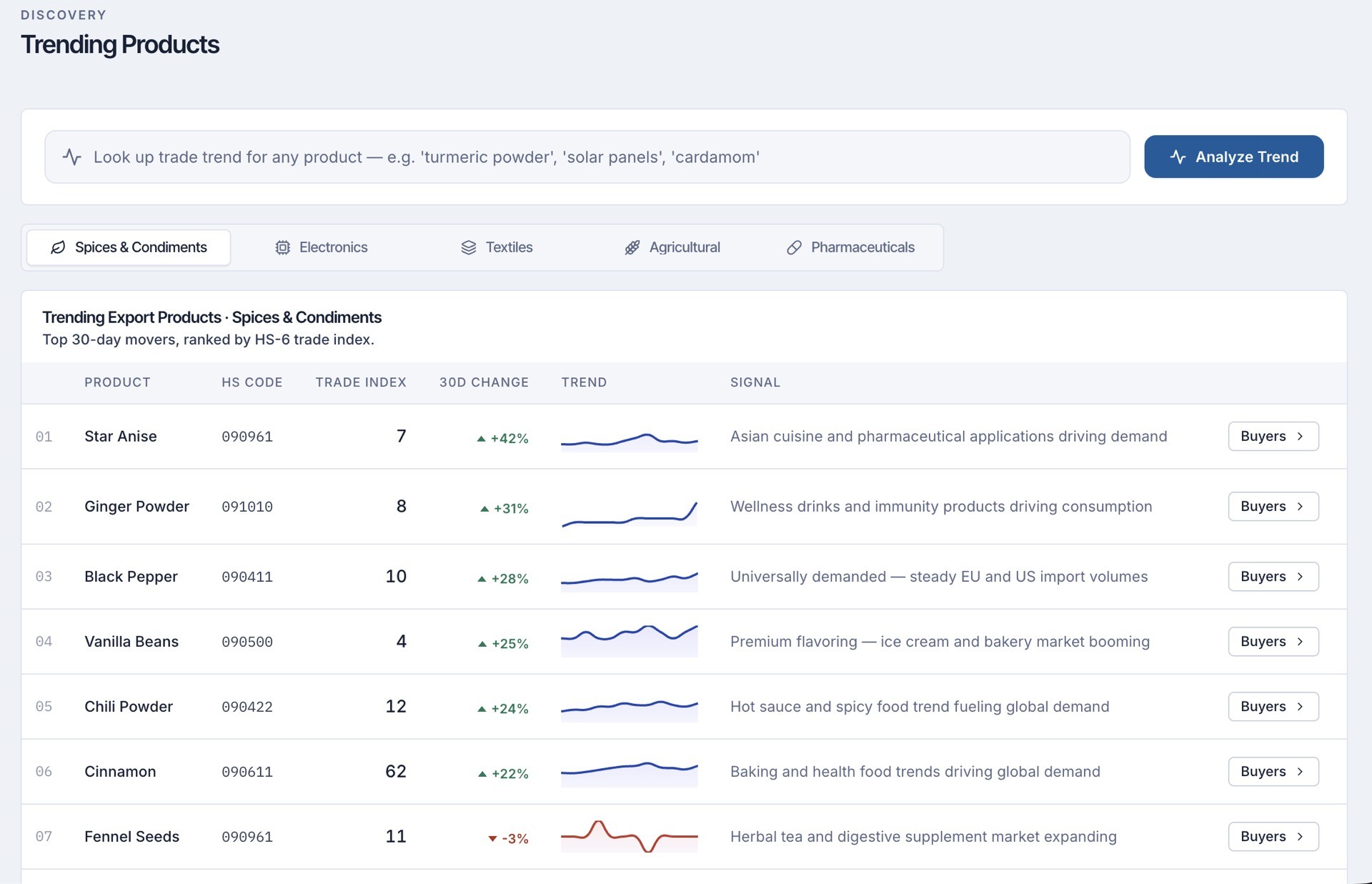
The ShipScout portal: Trending Products ranked by Trade Index Score.
Search, discovery, company profiles, trends, routes and competitor watch in one web workspace.
10 to 15 page company intelligence dossiers, and verification reports exportable for procurement files.
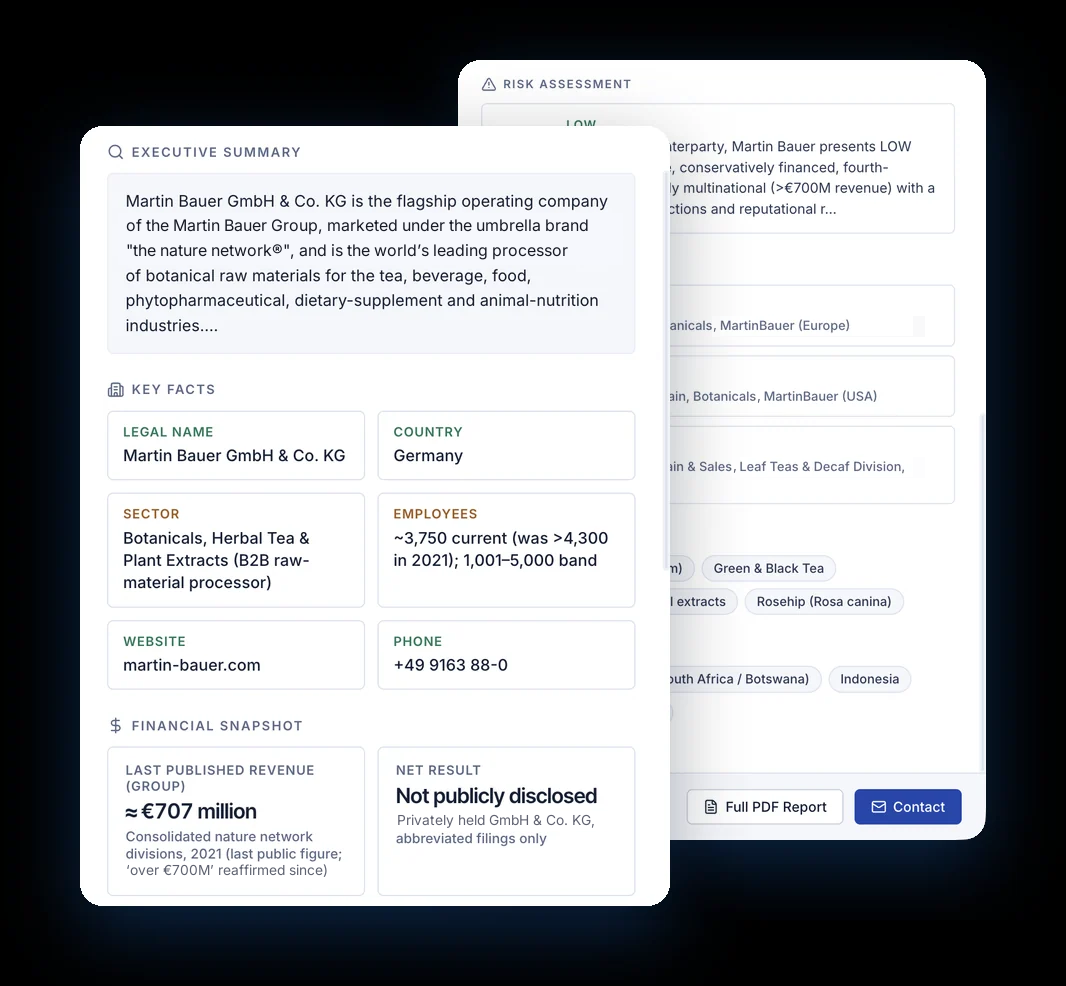
Questions answered in context, inside the portal, with outreach drafted for review.
Cmd+KProgrammatic access for teams that want the intelligence inside their own systems.
Enterprise tier07Security and privacy
These are the operating principles behind our platforms. They are commitments in how we build, not third-party certifications.
Intelligence is built from licensed trade records and published market sources.
No paid listings, no paid scores and no paid removal of red flags. We verify without commercial ties to the companies we score.
Deterministic models: the same inputs give the same score, and every verdict traces back to underlying records.
Verification reports show recent shipment rows with buyers masked.
The assistant reads your own searches, CRM and tracked competitors to answer your questions, inside your account.
Intelligence is delivered through signed-in accounts, issued reports and, on the enterprise tier, API access.
For enterprise buyers
Straight answers about the data, the scoring and how the intelligence is delivered.
Licensed shipment records covering 150+ countries, with 1.4M records added every month, plus a market intelligence feed on tariffs, trade agreements and port disruptions, and company and contact information gathered alongside the trade record.
Entity resolution. Spelling variants and duplicates are merged into a single record per company across 15.7M+ companies, so trade history, partners and contacts add up in one place.
No. Suppliers cannot pay to be listed, to raise a score or to remove a red flag. Scoring is deterministic: the same inputs always give the same score.
A TradeScore from 0 to 100 with a letter grade, export status and years active, shipments, buyers and markets, a 12-month trend, a red-flag screen, recent shipment rows with buyers masked, and a plain verdict: proceed, proceed with precautions, or walk away. Reports export for procurement files.
ShipScout intelligence reports are 10 to 15 page dossiers, delivered in 48 to 72 hours.
Yes, API access is available on the ShipScout enterprise tier. Tell us what you want to connect.
ShipScout has a 14-day free trial with no card. The first TradeVerify check is free, also with no card.

Bring a product, a market or a counterparty. We will run it through the record with you.